4 Ways to Put Your Life on Automatic

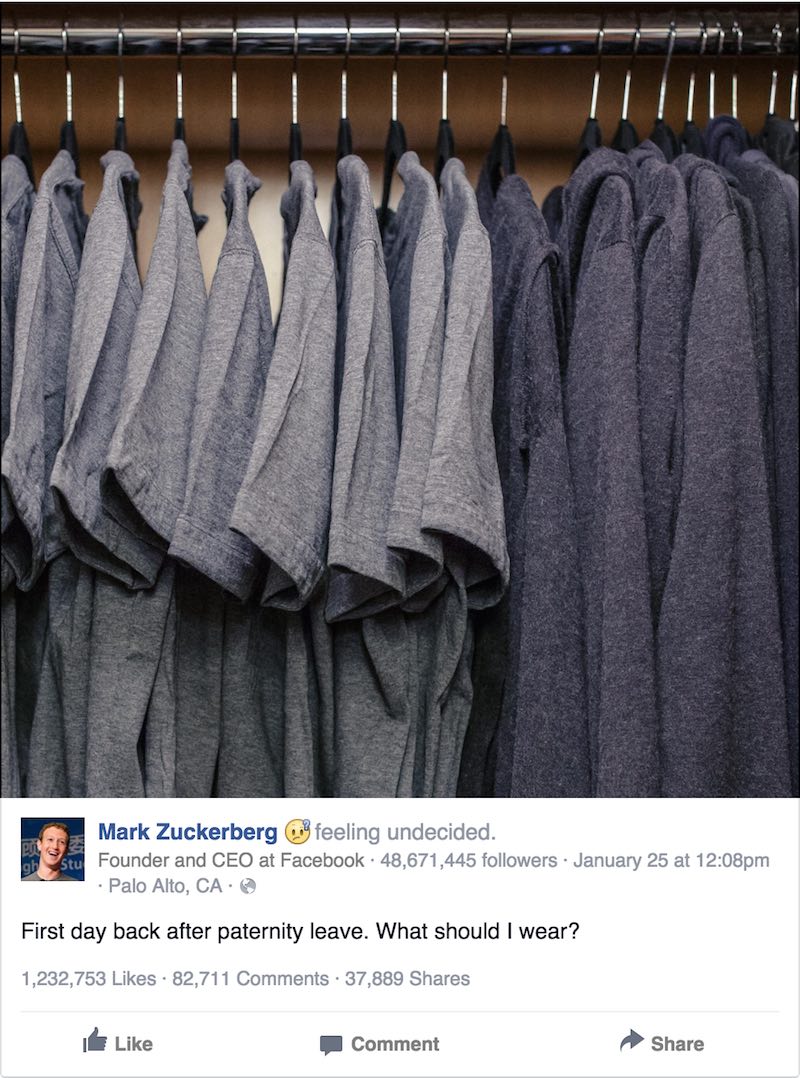
While Steve Jobs is perhaps the most famous uniform wearer of recent times, he is/was not the only tech billionaire with such a predictable wardrobe. Facebook founder and CEO Mark Zuckerberg is also fond of wearing the same thing day in, day out. In Zuck’s case, it’s a grey t-shirt and blue-grey hoodie matched to a pair of jeans. In a short talk he explains why:

I’m in this really lucky position where I get to wake up every day and help serve more than a billion people. And I feel like I’m not doing my job if I spend any of my energy on things that are silly or frivolous about my life, so that way I can dedicate all of my energy towards just building the best products and services.

Leaving aside whether you believe Zuckerberg is trying to help a billion plus people and whether you agree that the clothes we wear are “silly or frivolous,” the gist of his logic remains: we have a finite amount of time and attention for the things we find important. Any reduction in decisions surrounding unimportant things frees our time and attention for important ones. For him, the decisions he makes at work are more important than deciding what shirt to wear for the day.

While we have been known to over express our advocacy of uniforms, they are far from only way to streamline decision making. Our lives are filled with staple decisions and other attention-grabbing activities, ones that can be standardized without compromising the quality of our lives. Here are a few: 

  • Standardize food choices. Many of us eat food every day and some even eat three meals a day, which is three, sometimes agonizing, decisions. Aside from skipping meals (something this author frequently does), we can standardize our daily meal plans, either eating the same thing for several consecutive days or, if you want a bit more variety, choosing between a set amount of dishes, e.g. lunch is either pasta salad, turkey sandwich or avocado wrap. Even standardizing two of the meals (breakfast and lunch are the easy targets) helps to make our lives a lot smoother.
  • Autopay bills. Welcome to the 21st Century, a time when we no longer have to remember to pay our bills. Sure, it’s good to be aware of how much money we’re spending, but really, how often do we contest the gas or phone bill? Most bills can be both sent electronically (i.e. no snail mail) and put on autopay, automatically charging your credit card or withdrawing funds from your bank account at a set time. If it makes you feel better, glance at your account online to make sure everything is on the up and up. Imagine a world where you never have to think about overdue bills. What would that freedom permit you to do? 
  • Refine your daily routine. For better or worse, the vast majority of our days are filled with repetitive tasks: getting ready for the day, set tasks at work, cooking dinner, going to bed. Given the repetitive nature of our lives, why not get really good at our routines? Find the swiftest path to making coffee, working out, knocking out email at work, cleaning dishes at night, etc. If it can be done, it can probably be done better, faster and with less effort. 
  • Make standing appointments. Similar to the point about routine, most of our lives are filled with things we regularly want to and must do: go to the gym, go grocery shopping, do laundry, spend time with friends and family, get haircuts, etc. Rather than doing these things “when we have time”–a tack that often results in not doing the things we want to do and squeezing the things we must do in last minute–we might try scheduling our lives. What happens when we commit to doing something at a set time is we: A. stop wondering when we’ll do it, thereby freeing up mental space; and B. build our lives around the standing appointments, thereby greatly increasing the odds of not running out of time and accomplishing both our want to’s and have to’s. Ironically, having those free spaces between the fixed appointments actually allows more time for spontaneity.

What activities do you standardize or automate to make your life simpler? Let us know in our comments section.

LifeEdited’s Top Posts of 2015

As the year draws nigh and vacations loom, we thought we’d look at 2015’s most trafficked posts published this year (“Build Your Own Murphy Bed for $275,” published shortly after this blog started in 2012, was and continues to be our all time most trafficked post). Without further ado, here they are:

5. Vogue Magazine Features Story of Couple Giving Up Their Stuff

Coming in at number five is this post about Prerna and Parag Gupta, a couple of techies who sold all their stuff to travel the world. Aside from the inherent ballsiness of the couple’s story was the fact that it was featured in Vogue–a magazine that’s not normally associated with minimal living.

4. The 600 Square Foot Family

The fourth most trafficked post was about the Muzereks, a Vancouver family who decided a small condo in a walkable area was a better fit for their values than big place in the burbs.

3. 2 Bedrooms, 4 Kids, 1 Mom, Lots of Ideas

buitoni

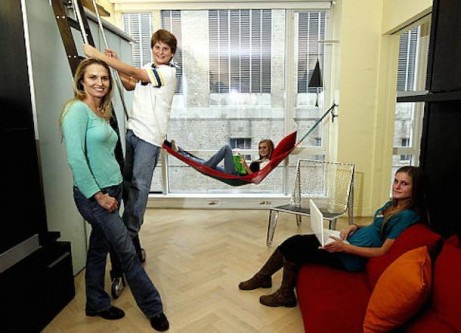
Keeping on the theme of urban families, this post took a look at Kip Longinotti-Buitoni, a single mom who left the burbs and set up camp for her four kids in a relatively small Manhattan condo, helped greatly by an array of transforming furniture. 

2. The Rise of the Minimalist Millionaire

This short post showed off the Airstream trailer that Zappos.com founder Tony Hsieh calls home. We think it falls along the line of the mainstream-ification of minimalism…something we think is a very good thing.

1. Paris Hilton Discovers Minimalism, Moves into Tiny House

This post about the alleged conversion of conspicuous consumption’s poster child proves that nothing gets traffic like celebrities…and humor.

Honorable Mentions

Frankly, the above list surprises us a little bit, but Google analytics doesn’t lie. Based on Facebook likes, you guys thought these posts were pretty interesting as well. 

3. Growing Old Together and in Style

This post about the “Cheesecake Cohousing Consortium” shows that small, communal living isn’t just about Millennials living in the middle of the city.

2. A Very Big Idea in Tiny House Living

simply-home

This story about a single family home with four tiny houses set up in its backyard is one of our favorites. It shows how density and community can be made inside America’s single family home-centric infrastructure.

1. The Rise of the Minimalist Celebrity

dan-norris

Alright, out titles aren’t that original sometimes, but this post about major league baseballer Daniel Norris seemed to strike a chord with readers. If you don’t recall, Norris intentionally chose to live simply out of his old VW bus, eschewing the bling that so often accompanies twenty-somethings with a few million dollars burning holes in their pockets.

5 Ways to Get Email Monkey Off Back and Put Him in a Cage

A recent article in Business Insider tells the tale of brothers John and Bert Jacobs, founders of the $100M “Life Is Good” t-shirt company. The brothers felt like they were being completely devoured by email. They write in their book “Life is Good,” “The time we spent daily just shoveling out our email inboxes was daunting. And we were going to bed at night feeling guilty and inadequate because we couldn’t get ahead. The more emails we sent out, the more flowed back in.” In a radical move, the two men ditched email…sorta. They actually delegated all of their email correspondences to other people in their organization. This act allowed them to step up their creative game and focus on high level business decisions rather than getting bogged down in putting out many small fires.

So I know what you’re thinking, because it’s what I’m thinking too: “Awesome! Two CEOs give their underlings all of their annoying, distracting emails. Good for them! I bet life is good. But I do not have any underlings. I am the underling and I can’t deal with my own email. Thanks for sharing.”

While most of us are likely not CEOs, the Jacobs’ experience can still be instructive. And though we might not be able to outsource our email responsibilities, we can, in all probability, find ways to liberate ourselves from asphyxiation by email (and for many of us, texts as well). Here are a five strategies that don’t include auto-responders: 

  1. Stop checking your email the first thing in the morning! For most of us, the morning is the best time to map out our day (if we don’t do it the day before). By checking email first thing in the morning, we start our days in reactive mode, playing whack-a-mole with our myriad responsibilities. By delaying our initial email check, we have space to create our day and decide how we want it to go. Don’t worry, all the fires in our inboxes will still be smouldering when we’re done planning. But chances are, the house will not burn down if we give ourselves 15-30 minutes to figure out what we want to do with the day first.
  2. Things can wait. I learned this concept from Tim Ferriss, who says there are few real emergencies, so we should create certain times to deal with email (aka “batching” email). Think about it. Most of us check our email all the time because we believe something important might be in one of the emails. But is this true? While many emails present things that need to be handled, often those things can be handled in their right time, which, in all probability, is not when the email comes in. Let’s say we’re writing something–a blog post, for example–and our boss asks us to send him a file. Unless that boss is boarding a plane in five minutes, he can, in all probability, wait. No one is going to die. Deals won’t fall through. It is probably a better idea to finish what we’re doing then send the file when ready. Studies actually show that multitasking makes us less productive and stupider. That’s right, when we bounce from thing to thing–writing a proposal to emailing to paying bills and so forth–we bring fewer IQ points to each one of those tasks than we would if we did each one from beginning to end.
  3. Slow the hell down. Have you ever emailed with someone who always responds to emails immediately? Or, worse yet, are you that person? Then one day, that person delays. One minute, two minutes, two hours…nothing. What the hell? Did I do something wrong? Here’s the deal: nothing’s wrong. She probably getting something to eat or do one of the million other things people do in the course of their day. The real problem is setting up an expectation of instantaneous responses. Along the lines of points #1 and #2, sometimes it’s not the right time to respond. It’s okay to respond when it works unless it’s an emergency…and it’s almost never an emergency.
  4. Turn off push notifications on your phone. This is one I don’t practice, but boy does it make sense. Those insidious banners, rings and buzzes on our phone are begging to take us out of the moment and task at hand. Screw em. They can wait. What we’re doing–even if we’re doing nothing–is probably more important.
  5. Create safe spaces from email and texts. At the dinner table, during weekends, in bed–create places and times when you cannot be reached any way other than phone. It’s vital we ensure our days include times when we cannot be reached. I don’t know about you, but anyone who would relay important information has my phone number. So if someone important really needs to relay important information, he or she will call.

If you have other strategies, please share in comments section (i.e. don’t email me ;-).

5 Stuff-Free Gift Ideas

According the website Nerdwallet, it takes the average middle-class American household three months to pay off their holiday gift-buying expenses. Unfortunately these arrears, taken on in the spirit of generosity, are often taken on for naught. Research shows that many, if not most, of our gifts are undervalued and/or disliked by the people we give them to. Not to be too humbuggy, but I suspect the average gift probably has a 50% chance of being well received and/or used (I’m assuming this is a gift that wasn’t specifically requested by the receiver). Would you buy stock in a company where there was a 50% chance the stock would be worth nothing within weeks of buying it? Probably not.

With all this in mind, it’s a good time to suggest some stuff-free gift alternatives–“things” that are almost sure to be used and enjoyed and will not (and cannot) be tossed or given away moments after they are received.

  • Don’t get “stuff.” There are many ways of giving gifts that require no extra storage. Buying experiences–theater or movie tickets, a dinner at a nice restaurant, etc–have actually been shown to have a higher likelihood of being well received than stuff like electronics or blenders.
  • Give a service. Back in the day, you might have given someone a CD, DVD or some other durable good. In their place, buy a subscription or gift certificate to Spotify, Netflx or maybe Airbnb.
  • Give a membership: Museums, zoos, performance spaces, etc. What’s great about this gift is that people end up going to these institutions frequently when they might not have gone at all without a membership.
  • Give food or drink. When doing this one, it helps to have some notion of the recipient’s gastronomic leanings (does he/she like stinky cheese, coffee or tea, bourbon or wheat grass), but food is infinitely consumable and appreciated by most.
  • Give time. We still love the “One Less Gift Certificate” devised by Miss Minimalist. In an age or material abundance, time and attention are far more precious commodities than money or anything you can buy at a store or order on Amazon.

How are you prepping for the holiday season? Let us know in our comments section.

A version of this post originally published November 26, 2014.

Let’s go shopping image via Shutterstock

Combating Consumerism with Kids

Today’s post was written by mother and minimalist Jen Adams.

I have 13 children. That’s not a typo–thirteen. 5 adopted, 4 biological and 4 “step”–although don’t tell them that. Our kids range in age from 5 to 23 years old. We still have 10 at home–seven in high school, two in middle school and the last in kindergarten. It. Is. Awesome. And challenging.  We live in a 1700 sq ft home with four bedrooms and two bathrooms. The bedrooms are shared–four boys in one, three girls each in the other two and my partner and I in the last. The bathrooms are always shared. We began the process of intense minimalism in February 2015 when, as parents, we couldn’t take the clutter anymore. One of the biggest foes of minimalism, especially for impressionable younger people, is the influence of consumerism.

Regardless of your income or your priorities, consumerism an issue parents have to face, and particularly so if you’re trying to maintain a minimalist home. No matter how often you succumb to “the gimmes,” someone or something will always be peddling more. Commercials on TV, ads on the internet, friends who own more “stuff,” the ability for social media to track what you look for and like–it’s never ending. Want to be thinner? Faster? Stronger? Better looking? Have more energy? Look better? There seems to be a product that will fix whatever problem you might have.

But for us, resisting the urge to give in to consumerism wasn’t just about having less stuff and saving money (those are important). We wanted to about teach our kids values. I wanted them to learn:

  • That instant gratification isn’t all its cracked up to be
  • That stuff won’t make you happy
  • That you can’t get everything you want
  • That you have to work for what you want
  • That you should prioritize what’s of value and be willing to earn it

My kids are older now and I thought I’d ask them how our journey into minimalism is going–if any of these lessons have stuck. I spoke to six of them, asking them what it’s been like growing up wearing hand me downs, shopping at thrift store, having me bake their birthday cakes at home, making all their Halloween costumes and Christmas pajamas and being regularly told no when they asked for things they had to have. Here’s what they said:

gabi

Gabi–15 years old: “It sucks being told no sometimes when you want something, but it taught me I don’t have to get everything I want. I like the homemade Halloween costumes and birthday cakes from scratch because it means more and there are memories. Hand me downs are pretty cute clothes. Thrift stores means stuff that’s expensive is cheap and we can get it, so it’s pretty cool. I don’t mind getting rid of things because I don’t use things so my mom minimizing doesn’t bother me. Our house isn’t crowded like it was before we minimized and that feels better. “

alana

Alana–17 years old:  “[Sighs] I never did get that pillow pet I wanted” [She then proceeded to sing the commercial–be thankful I didn’t take a video.] “It taught me that having a few sentimental things is more important than having a lot of things. It’s more meaningful. It was frustrating not getting things when I was younger because other kids had stuff that I didn’t and it seemed like it was cool. I felt like I never got any of the cool toys. Now I’m really glad. I’m not an entitled, stuck up snob and I learned to be more creative.”

taylor

Taylor–16 years old: “It was nice because I didn’t have that privileged mindset that I’ll have everything I want. I learned how to work for things and earn them. Homemade Halloween costumes, Christmas pj’s and birthday cakes. It meant a lot that my mom took the time to do that stuff.”

olivia

Olivia–19 years old: “It was just how I was raised. If you don’t know any different you don’t realize there is anything different. Homemade birthday cakes are always better than store bought anything. Mom made things so there was good stuff in it and we were allowed to lick the bowl which always made it better, plus we got to pick the cake we wanted from pictures. We still had a lot. I never felt like I didn’t have enough. The only thing I remember wanting to do and being told no was wearing a belly shirt. I was really mad. It was a green, waffle material. That kind of sucked. The want vs need thing–I make a list of what I need first and then things I want.  So I learned to know the difference between wants and necessities. That’s great for planning ahead and not splurging on things I don’t actually need.”

kezia

Kezia–13 years old:  “I don’t like being told no. Mainly because I’m one of those people that want everything. It taught me that I didn’t need things just because I wanted them.  I didn’t mind hand me downs or going to the thrift store because the clothes were cute. The one thing I don’t like is that they aren’t always ‘in’ and fashionable but I learned to make them fashionable. I like the homemade costumes so we could make them and no one else had them. I liked the homemade cakes because they were made with love. One of the biggest things is that we learned to help each other because we did things together. It brought us closer together.”

ashlea

Ashlea–15 years old:  “It sucked at the time, but looking at how other families are who have spoiled kids, [has] made me appreciate less consumerism as I got older. I didn’t like getting hand me downs but I learned I’d rather have a few nicer things than a lot of things.”

[divider]

The bottom line is who the hell cares how you’re raising your kids. People–even strangers–like to offer advice on parenting, but we all parent in dynamically differing ways. You must do what works for you. For us, living with less stuff, not buying everything the TV tells us to, buying used when we can, making stuff ourselves and so on, works. While our kids might not always be happy when we tell them that they can’t have what they want, as they’ve gotten older, they seem to appreciate that we are doing it because it works for the family. And if I do say, in spite of not getting everything they want–or because they don’t get everything they want–they’re doing pretty okay. 

Read more about from Jen and her family’s adventures at Mom’s Running It

4 Easy Ways to Edit Your Diet

I think there’s a certain ideal in the minimalist’s mind of reducing her or his consumer behavior to only the most essential things. And let’s face it, there’s a bunch of chaff that can easily be removed without too much justification in our quest of this ideal. We can cut out the clothes, the electronics, the new cars and maybe even the extra 500 square feet from our homes. But there’s one thing that seems to defy editing, and that thing is food. Even the most hardcore, tiny-house-dwelling, uniform-wearing minimalist has to eat. But needless to say that just because we all have dietary needs doesn’t mean that all diets are the same. How and what we eat can greatly influence the amount of food we consume. Even if you are a “live to eat” sorta person like me (versus eat to live), buying, preparing and eating food can be an expensive and time consuming affair. And let’s face it, eating a little less is not a bad idea for most of us.

Here are a few tips to consume less food, all without compromising your health, and, in some cases, improving it.

  1. Skip breakfast if you want. Yes, I know what your mom said. The Surgeon General may have said it too: “Breakfast is the most important meal of the day.” Well, turns out this maxim is not rooted in fact. One of big misconceptions fueling this myth is that stoking our metabolism early in the day keeps us from binging later. But a recent Columbia University study found that “In overweight individuals, skipping breakfast daily for 4 weeks leads to a reduction in body weight,” as reported by the Washington Post. Across the board in that study and others, the findings are clear: people who skipped breakfast either lost or maintained their weight, but never gained. Now listen, if you eat breakfast and it works for you–giving you energy and helping you maintain a healthy weight and disposition–rock on. But if you’re eating breakfast because your mom said you should, not because it makes you feel healthier, it’s now okay to put down the cereal bowl.
  2. You can skip other meals too and skip eating for a while on occasion. A growing body of research supports the idea that the human body not only survives, but even thrives with regular vacations from eating. From an evolutionary standpoint, this makes sense. For millions of years, we couldn’t simply reach into our cupboards or fridges to munch or prepare eight small meals a day (we might have foraged, the primal version of snacking, but we couldn’t necessarily do this all year round). Numerous studies bear the power of taking regular–though not necessarily total–breaks from eating. One such study had people alternating between fast and feast days; a fast day would entail them eating 25% of their normal caloric needs and the feasting allowed them to eat what they wanted. Researchers found that following the fast days, people only ate 115% of their normal caloric intake–more than 100%, but lower than the 175% that would logically follow from the previous day’s 75% caloric shortfall. This pattern led to consistent weight loss. Moreover, following a 3.5 day adjustment period to the fast/feast diet, a period when people reported feeling deprived, 80-90% of people were able to stick with a new, calorie restricted diet. Even if you’re not looking to lose weight, restricted calorie diets are one of the few things consistently shown to increase human lifespans and fend off a host of ailments such as cancer, diabetes and other chronic illnesses. Another big bonus of fasting is its simplicity. There are no scales, no charts, few do’s and don’ts. Simply eat less for certain stretches of time, or as nutritionist John Bernardi told The Atlantic about the practice, “Relax. So you missed a meal. Who cares? Might even be good for you. Just keep going.”
  3. Focus on foods that have a high nutrient/weight ratio. If you must eat (it happens to the best of us) try the less but better approach. The fact is many of the constituents of the Standard American Diet (SAD) are like the McMansions of food world–tons of volume and little practical (i.e. nutritional) value. On the other hand, things like seaweed, collard greens and watercress are like the transforming micro apartments of the food world, doing a whole lot without much volume or mass. Take a look at the ANDI Guide (Aggregate Nutrient Density Index) to see how various foods stack up in terms of their nutrient density relative to their weights. Kale for example scores a perfect 1000 on the scale. Soda scores a 1. The inventor of the scale, Dr Joel Fuhrman, says we don’t need to excise all foods that are 900 and above to ensure “proper functioning of the immune system and enable the detoxification and cellular repair mechanisms that protect us from chronic diseases”–the ostensible benefits of eating a nutrient–and more specifically “micronutrient”–packed diet. He does say we should have “micronutrient diversity, and eat an adequate assortment of lower ranked plant foods to obtain the full range of human requirements…mostly foods that have an ANDI score greater than 100.” Virtually all of these +100 foods are fiber rich, leading to greater satiation and therefore smaller overall dietary needs.
  4. Reduce your portion size. This is a topic we explored a while back with the “Small Plate Movement,” which promotes using smaller plates to help us eat less. One study the movement cites says that people will eat 70% of their plate’s portion, regardless of the plate’s size–and 70% of a 10” plate is less food than 70% of a 14” plate, right? I’ve read some of the research and it’s not quite as compelling as the other suggestions on this list, and it doesn’t necessarily jibe with my experience (I have little shame about getting seconds). That said, it might save room in our cupboards and it certainly can’t hurt.

[Disclaimer: The information contained in this article is not meant to be prescriptive or authoritative. If you are considering implementing any of these tips, consult with an expert first.]

Heap of fresh fruits and vegetables in basket image via Shutterstock

You Probably Don’t Need That

The world is brimming with awesome stuff. Amazing products. Gorgeous clothes. Exquisite artifacts. Fast cars. And electronics. So many awesome electronics! Smartphones, laptops and apps galore. There’s no question that we live in an age of unfathomable material bounty. And you know what? In nine cases out of ten, the chances are that you don’t need any of this stuff. Your current stuff probably works great. Your clothes clothe you with style and function (okay, you might need a couple pair of new socks). Your current car works great (it might need an oil change). And electronics, oh electronics–your iPhone 4 is awesome (like Star Trek, holy-crap awesome); your four year old laptop that starts up reliably, is a marvel–maybe not a marvel like the one that just came out yesterday, but a marvel nonetheless; and c’mon, you know you’re probably not going to use that awesome app in a week.

Remember, all of our stuff has an impact, be that impact psychological, financial, spatial (i.e. clutter) or environmental (the latter point can’t be overstated). The best course is normally to just not get it. And if you do get it, if you determine it’s something you really need, or, more likely, really want, make it count. Get the great stuff. Stuff you’ll cherish, care for and keep.

So if you’re on the fence about getting some new stuff, just remember, the stuff you have is awesome. You probably don’t need that.

Just say no image via Shutterstock

Add Privacy to Your Small Space with White Noise

Let’s say, theoretically of course, that you live in a small two-bedroom apartment with your wife and two children. One child is a not particularly deep-sleeping newborn, the other is a toddler with a voice that sets off car alarms when he finds out his fire truck pajamas are dirty. Light-sleeping baby + yelling toddler = parents wishing they had a floor or two more or very long hallway between bedrooms. If it weren’t for our white noise maker, we’d totally lose our collective s@#t.

While white noise is not as effective as distance, solid walls or special soundproofing in terms of eliminating sounds, it is very effective given how easy it is to employ. Rather than eliminating sounds, it adds a layer of flat, neutral sound that dulls sharp, disturbing sounds.

In my home, we use the aptly named “White Noise” app by TM Soft. We have it hooked up to an old iPhone and typically use the white or brown noise settings, though there is a huge range of sounds available including hairdryer and grandfather clock (we sprung for the $1.99 premium version with a huge catalogue of sounds).

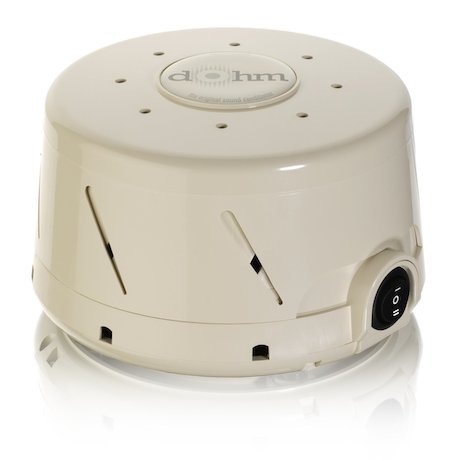
marpacIf you don’t have an old iOS device or want something non-digital, the Marpac DOHM-DS is the go-to device for psychologist waiting rooms around the globe. It’s a small fan wrapped in a case with small vents that, depending how open or closed they are, allow you to modulate the sound. I’ve used the Marpac extensively in the past and like it, though I find my old iPhone gets considerably louder.

Though I don’t have experience with them, there are numerous white noise makers specifically for babies as well as countless other apps for both iOS and Android. Should the tinny sound of your phone’s speaker be bothersome, pipe the sound through a set of Bluetooth, Airplay or desktop speakers.

White noise is not just for parents with small children. Use it when you need to make a private phone call and your roommate is in the other room or to dull out the sounds of noisy neighbors. Living in small spaces near other people has many perks, but sound separation is typically not one of them. Cranking up the white noise (to less than 85 dB apparently) helps create some of that separation and a little bit of sanity.

The Hamper Test

Most of us live under the assumption that a decent percentage of our wardrobes are comprised of clothes that aren’t worn often. One closet expert (someone who knows closets, not someone hiding the fact she’s an expert) told the Wall Street Journal that most people only wear 20% of their wardrobes. This need not be the case. We can have wardrobes where every item is loved and worn on a regular basis, where we could reach into our closets blindly and be happy wearing whatever we pulled out.

If you want to reduce the volume of clothes you have while simultaneously increasing the overall quality of your wardrobe, consider doing the Hamper Test. Here’s how it works:

  1. Determine the normal interval between laundry loads. For some that’s five days, for others a week, for some two. For people who do laundry often, err on the side of making your interval long. It’s okay if your laundry interval is tethered to someone else’s, like a spouse; just determine your combined laundry interval.
  2. When you do laundry, look at the clothes not in the hamper (or laundry bag)–the clothes that are not in active rotation.
  3. Get rid of at least one item that didn’t make it into the hamper per laundry interval.
  4. Repeat until most of your clothes are in the hamper at the end of a laundry interval (some prudent reserve of unused, but wearable clothes can be forgiven).

There are a few notes to the Hamper Test:

  1. Don’t subject seasonal clothing to test when out-of-season. In other words, don’t ditch your shorts because they didn’t make it into the hamper in December. But do subject shorts to test in August (make appropriate hemispheric/seasonal adjustments). The test should be done for every season, i.e. conduct test in summer, then do separate test in winter.
  2. Clothes that are either infrequently or dry-cleaned won’t exactly fit into the Hamper Test. Just be honest about how often these things are worn.
  3. You can make some special clothes exempt: Formal wear and specialty clothes (ski pants, cycling shorts when not in season), for example. But do not abuse this exemption. If you haven’t worn that tux in the last twenty years, there’s a chance you won’t wear it in the next twenty.

Even people who think they have pretty pared down wardrobes (like this author) find dozens of things to give away: t-shirts at the bottom of the t-shirt stack, those “funky” neon green socks that are worn once a year (at most), cycling clothes that haven’t been worn for 12 years and so on.

Give it a shot and let us know how it works.

Washing fabric in Basket image via Shutterstock