The High Cost of the Guest Room

Pulling data from the US Census, Finder.com found there are 9.4% more bedrooms in the U.S. than people: 357M bedrooms but only 323.4M people–a 33.6 million bedroom surplus. This figure, they note, is probably very conservative because it assumes one person per bedroom and many couples share a bedroom.

This surplus is not just a waste of good mattresses, but money. They suggest putting those spare rooms to use. Rent them, Airbnb them, do something other than letting them sit as big dust traps. They estimate that renting all of these rooms for a mere $100 week would yield $174B. But that figure is super conservative too: “Americans in bigger cities could get significantly more than the national average. For example, Phoenix residents can get $338 a week ($17,576 a year), while people in Nashville, Tenn., can rake in $572 a room per week to the tune of nearly $30,000 a year.”

We might also suggest that developers and architects start channelling their energies toward smaller–or at least more flexible–spaces. And for people looking for a new home to start purchasing/renting/demanding smaller homes, armed with the knowledge of the real costs of keeping a room (or rooms) on standby.

Via CNBC

Sell Stuff Now, Easily

We’ve given tons of tips for selling your stuff. You can get an eBay valet to do it for you, you can sell your stuff on CraigslistKrrb or Yerdle. And of course, you can just give stuff away. With the exception of using an eBay valet and donating stuff, most strategies generally leave the seller (you) to be your stuff’s shipping and inventory manager. For those looking to make rapid life edits, this can be an agonizing process, both waiting for your stuff to sell and dealing with it when it does sell, all serving as a protracted reminder of all your poor life purchase decisions. A new service called Stuffhopper does something different, relieving you of pretty much all responsibility aside from waiting for someone to pick up your stuff and making money.

Unlike an eBay valet, Stuffhopper accepts a huge range of stuff–from furniture to appliances to handheld electronics. You describe your stuff to give them a sense of what you’re selling (they understandably don’t want your broken junk). You then schedule a pickup (if the value exceeds $100) via their site or app. Stuffhopper then goes about creating listings for your stuff, photographing it, creating descriptions and then selling it on whatever channel(s) are most appropriate. Because they are expert sellers, they know how to price and market your products better than you ever would. When they sell the stuff, they take a 50% cut of the net sale and give you the rest. If stuff doesn’t sell in 60 days, they send it back free of charge or donate it with your blessing.

Stuffhopper claims that the average house contains $7K worth of unused stuff. But for many of us, the value proposition of accessing that money–the time and effort involved with selling–isn’t sufficiently compelling to motivate us to do anything about it. Stuffhopper could change that.

Unfortunately for most of us, Stuffhopper is only available in Seattle, but we think it’s an idea that has legs and hope it expands to other cities.

Via Geekwire

Get Space When You Need It Most

One of the core ideas behind living an edited life is access over ownership. The fact is that many of the things that are useful for certain times are liabilities most of the other ones. To illustrate, if you’re throwing a big birthday bash, having a room in your house that can hold 75 people is useful. But when the party is over, you’re left with a big room to maintain, heat, cool and pay for. Services like Airbnb create a great solution to these kind of problems, both allowing people to access sleeping accommodations when needed and making sure spaces are being used to their fullest potential. Now a site called Peerspace does for event spaces what Airbnb does for guest accommodations.

Peerspace’s tagline is “Connecting people with unique spaces.” The site is a peer-to-peer booking site that lets you rent spaces for events, photoshoots, concerts, etc. Spaces run the gamut from small boardrooms to massive event spaces. Each space’s profile provides high quality images of the space, its amenities, availability and rates. Of course, Peerspace can be used as a place to book a space or rent out yours.

If you’ve ever organized events, you know how difficult it can be finding, much less comparing, good spaces. Peerspace makes the process pretty damn simple. Right now, PeerSpace has networks in New York City, LA, San Francisco, Seattle and Austin.

LifeEdited’s Top Posts of 2015

As the year draws nigh and vacations loom, we thought we’d look at 2015’s most trafficked posts published this year (“Build Your Own Murphy Bed for $275,” published shortly after this blog started in 2012, was and continues to be our all time most trafficked post). Without further ado, here they are:

5. Vogue Magazine Features Story of Couple Giving Up Their Stuff

Coming in at number five is this post about Prerna and Parag Gupta, a couple of techies who sold all their stuff to travel the world. Aside from the inherent ballsiness of the couple’s story was the fact that it was featured in Vogue–a magazine that’s not normally associated with minimal living.

4. The 600 Square Foot Family

The fourth most trafficked post was about the Muzereks, a Vancouver family who decided a small condo in a walkable area was a better fit for their values than big place in the burbs.

3. 2 Bedrooms, 4 Kids, 1 Mom, Lots of Ideas

buitoni

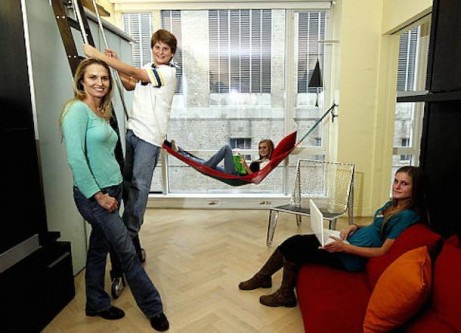
Keeping on the theme of urban families, this post took a look at Kip Longinotti-Buitoni, a single mom who left the burbs and set up camp for her four kids in a relatively small Manhattan condo, helped greatly by an array of transforming furniture. 

2. The Rise of the Minimalist Millionaire

This short post showed off the Airstream trailer that Zappos.com founder Tony Hsieh calls home. We think it falls along the line of the mainstream-ification of minimalism…something we think is a very good thing.

1. Paris Hilton Discovers Minimalism, Moves into Tiny House

This post about the alleged conversion of conspicuous consumption’s poster child proves that nothing gets traffic like celebrities…and humor.

Honorable Mentions

Frankly, the above list surprises us a little bit, but Google analytics doesn’t lie. Based on Facebook likes, you guys thought these posts were pretty interesting as well. 

3. Growing Old Together and in Style

This post about the “Cheesecake Cohousing Consortium” shows that small, communal living isn’t just about Millennials living in the middle of the city.

2. A Very Big Idea in Tiny House Living

simply-home

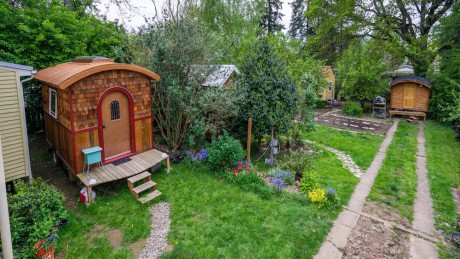
This story about a single family home with four tiny houses set up in its backyard is one of our favorites. It shows how density and community can be made inside America’s single family home-centric infrastructure.

1. The Rise of the Minimalist Celebrity

dan-norris

Alright, out titles aren’t that original sometimes, but this post about major league baseballer Daniel Norris seemed to strike a chord with readers. If you don’t recall, Norris intentionally chose to live simply out of his old VW bus, eschewing the bling that so often accompanies twenty-somethings with a few million dollars burning holes in their pockets.

Breather Investment Might Show that People Will Subscribe to Anything

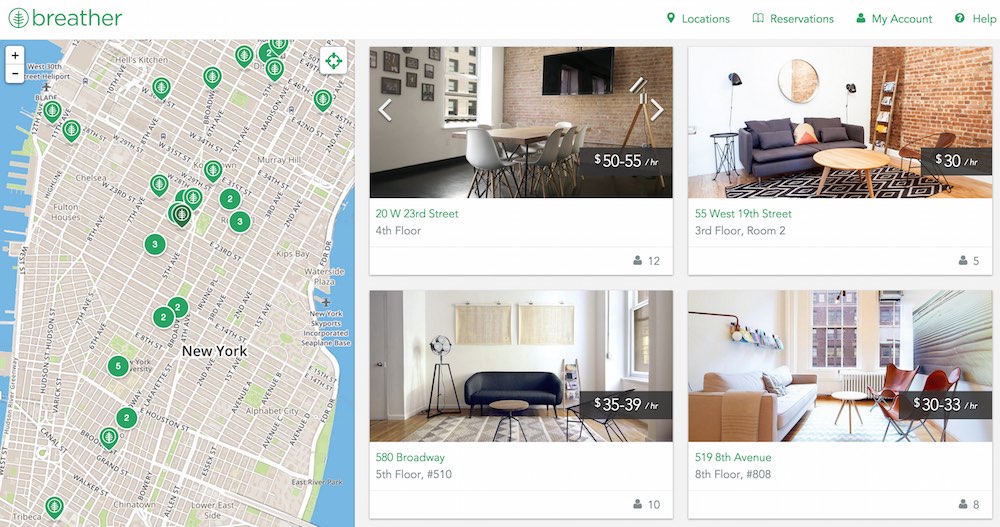
This site profiled the company Breather a couple years ago right after its launch. For lack of a more original description, Breather does for living and meeting rooms what Airbnb does for bedrooms. Via its site and app, Breather allows on-demand rentals of quiet, clean, wifi-enabled spaces in cities across North America. These aren’t places to stay for a long time; rentals are anywhere from 30 minutes to a day. These are place to work, have a quick meeting, meditate, breastfeed or simply get some quiet in an otherwise hectic day.

Today, Breather announced that it raised $20M of series B funding led by Peter Thiel’s Valar Ventures. This is a lot of money invested in a product that has no competitors or established market. Despite this–or perhaps because of this–the Breather capital influx may well be a harbinger of things to come, evidenced by its esteemed investor pool. If you’re not familiar with Peter Thiel, he cofounded PayPal with Elon Musk; he was the first outside investor in Facebook; he’s founded a number of other ventures that would be career-defining for most people to boot. He’s a man with a knack for seeing what’s next. So what does he (and a slew of other investors, it should be noted) see in Breather?

A few months back, I wrote a post called “Life as a Service (LaaS).” The concept of the post was based on the term Software as Service (SaaS)–an increasingly common model where software companies (Adobe, Microsoft, etc) charge a subscription fee for access to their software. The benefits of this type of service is that your software is forever current and you bypass many of the perils localized computing and storage. What I suggested is that this type of system can and is being applied to virtually every material need we might have, from cars to clothes to toys and more. In this model, things are accessed and subscribed to, not owned and paid for outright.

Yet I wrote the LaaS post with middling conviction, believing there were some things that would always defy shared or subscription-based ownership. You can’t very well subscribe to a living room, can you? But Breather shows that you can, and its continuation and growth are evidence of the growing catalog of things we may no longer own in the future. It also lends credence to the idea promulgated by Gunnar Branson about how real estate is being affected by Moore’s Law; through technology, we can access spaces that were once only available through ownership. Now we can use them only when we need them. Not only that, others can use the same space when they need them. This shared access has the potential to shrink our overall real estate needs, saving money, space and natural resources. It’s an exciting concept and one we look forward to seeing grow.

Zoku: The Home for Nomads

With the advent of high speed information technology, facilitating near-instantaneous communications and transfers of information from any spot on the globe, a new breed of global citizen has emerged. Often dubbed the technomad, this person travels light and often, living and working wherever there is a solid wifi signal. The new long-stay hotel Zoku is trying to provide a home for this population. Opening this fall in Amsterdam, Zoku is trying to be more than a temporary place to stay–it’s trying to be a home, an office, a complete living environment for the “location-independent” worker.

ZOKU Loft GIF

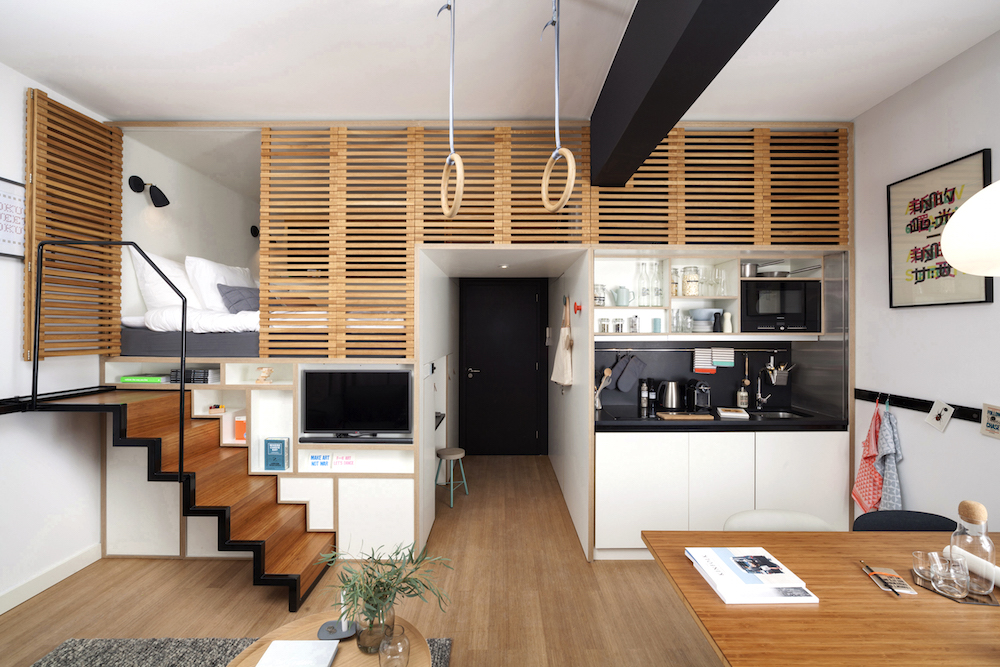
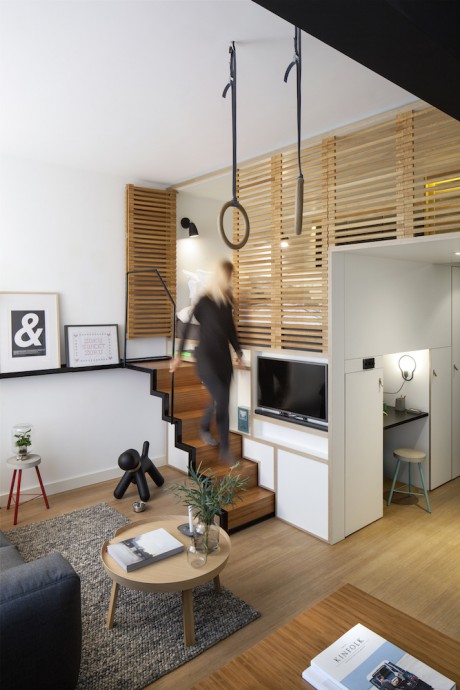
Zoku will have several levels of rooms starting with the basic Zoku bunk and Zoku room. However, their centerpiece is the Zoku loft (it’s also the only room they are offering pictures of at the moment). The loft is a full service apartment with elevated sleeping area, dining/conference table, kitchenette, lounge, enclave desk and a host of clever space saving features like retracting storage and stairs. With the loft, Zoku wants to shift the focus from the bed. Rather than mere place to sleep, the loft is a place to live. As such, the four-person table and sitting area–not the bed which is tucked out of the way–become the focal points of the room.

02 ZK1 overview03 ZK1 overview

Rooms have a la carte services like access to a guest pantry, an “office toolbox” with a printer and other office-y stuff, an “art swapping” service that allows you to change out art to customize your room for your stay, laundry and much more.

zoku-lounge

Amenity spaces include a co-working space, meeting rooms, a bar, a 24 hour (almost) everything shop, gym, decompression room, game room and more. In fact, the amenity spaces look so inviting, I would probably hang out there most of the time and choose a more basic room.

Exact pricing has not been announced just yet, but a representative said rooms will be in the three to four star range, with longer stays enjoying a volume discount. Zoku will start booking in July, and the company says they plan to expand into other cities in the near future. Check out more on livezoku.com.

What Would You Do If Money Weren’t An Issue?

The above question is one few of us feel the space to contemplate. Mortgage and rent, car payments, groceries, electric, gas, cell phone, internet, etc–the collective pool that we sum up as “bills” tends to keep us in a loop of work, pay, work, pay…pay funeral bill. Most people’s biggest bill is housing. One rule of thumb says that housing is about 30% of our income–a number that is higher for many. The number two expense is transportation, which is usually inextricable with housing. So it could be argued that if 40-60% of our living expenses were somehow magically paid for, we might be less inclined to take jobs that “pay the bills.” We might start doing things we love or that help people or that bring us satisfaction or all of the above. This housing-is-no-object equation is one of the main ideas behind unMonastery.

UnMonastery, as the name suggests, harkens back to monastic traditions–the monastery acting as a refuge to support a monk’s life of contemplation and service. UnMonastery has a technological and secular twist however. According to their site, they want to “recreate the best social functions of the traditional monastery: by giving the participants a collective purpose, a chance to develop deep relationships with one another and a reduced need to generate personal income so time can be dedicated entirely to serving the local community and contributing to global efforts in creating new digital tools.” UnMonastery finds as much inspiration from hackerspaces and coworking spaces as they do monasteries. The main point is that residents can eliminate or reduce living expenses as to live a life devoted to serving their community and the world, mostly, though not exclusively through digital tools.

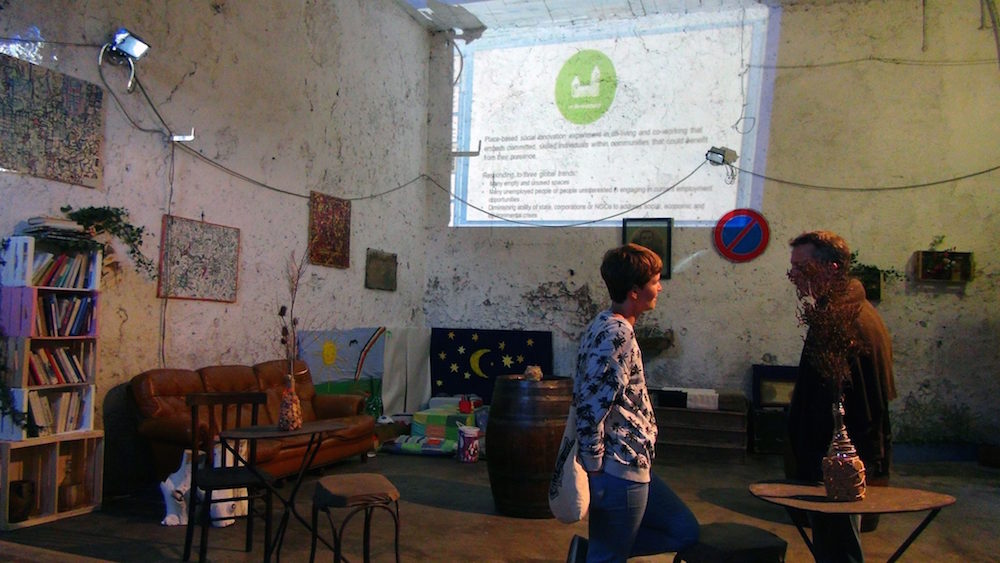
Though the unMonastery idea is not location dependent per se, they would like to build a network of communities around the world that “work together…autonomously…[and] prototype new solutions to common problems.” An initial unMonastery house was established early last year in the ancient southern Italian town of Matera (above pic is from their space); the unMonasterians set about addressing a number of local and global challenges. For reasons not entirely clear, that location was shut down. Currently, a new unMonastery is forming in Athens, a city whose citizens unMonastery claims “have a strong affinity to hacking of all sorts; be it with internet connectivity, food sharing, reactivating abandoned spaces, or just simply taking the metro.”

The modern world does not necessarily reward lives governed by purpose–unless that purpose is making money. As unMonastery posts on their website:

When it comes to work it is increasingly difficult to reconcile making money with making sense. People do work to make a living. Others do work to make meaning. But the two works are not the same work.

While unMonastery is a little too new (and unstable) to be recognized as a sign of things to come, it does point to one way things could be: a world where people are not working to live, a world where service to the greater good is valued above all else.


Life as a Service (LaaS)

Back in the day–and to this day in some places–people pumped from central wells, ground their wheat at central mills, baked their bread at central ovens and even bathed at centralized bathhouses. Primitive manufacturing technology limited private ownership for many common things to the very rich. The things people needed most were accessed, not owned. But as manufacturing technology and our ability to exploit the earth’s resources advanced, nearly everyone got his or her own oven, bath and iPad.

While there’s nothing inherently wrong with private ownership–and for many items it makes a ton of sense (even Sammy the serf had his own spoon)–the explosion of private ownership has had some pretty nasty consequences: 1. It sucks for the planet. It’s estimated that Americans, the kings of private consumption, consume over four earths’ worth of natural resources. And the rest of world is trying to keep up with us. China, as of a few years ago, was using 1.1 times the planet’s resources. These are extra planets we don’t have. 2. The profusion of private ownership is overwhelming owners. There was no equivalent for the Container Store in the 12th century countryside. You had your two frocks and a pot you shared with your family. Life might have been difficult and laborious, but it was simple. Nowadays, clearing clutter is a preoccupation. Really, don’t we have better things to do?

But the times are a changin. Through a combination of impending environmental calamity and technological advancement, it’s necessary and possible to offload many of life’s most basic stuff to centralized services and resources. Back in the day it was drawing water from the well. Now it’s pulling stuff from the cloud. Here are a number of areas where you can trade private ownership for shared services:

  • Housing: The popularity of the McMansion is inseparable from the private ownership ideal; these huge homes were meant as personal and self-sufficient kingdoms to be passed onto your progeny. On the other hand, places like the UK’s The Collective, offer housing as a service. Everything you need–much of which is shared–is included in your rent, or ‘service fee’ if you will. Micro-housing trades the notion of housing as agent of permanent security for low-fuss, minimal-resource, amenity-rich living.
  • Cars: Whether Zipcar, UberPool or (in the not-so-distant future) some sort of autonomous vehicle, it’s becoming easier and easier to live without your own car.
  • Computing: It’s no mystery that cloud computing is the way forward. Many software services like Adobe, Quickbooks and countless others are going cloud-only, offering Software as a Service (SaaS) eliminating the need for tons of local computing power and data storage.
  • Bikes: Most major cities–and many not-so-major ones–feature bike sharing systems, offering a viable alternative to owning a private bike.
  • Clothes: Dutch company Mud Jeans is offering their garments on lease. Rather than owning the clothes outright, you pay monthly for them and return them to the company, who recycles the material to be made into more garments. This is not a widespread model, but we hope it will be in the future.

Where else can private ownership be traded for service-based resources? Let us know in our comments section.

Co-Living for the 21st Century and Beyond

As we’ve seen recently with Stage 3 in NYC, The Collective in London and the expansion of the micro-apartment movement in general, there’s a growing market for minimal, all-inclusive, affordable, community-centric housing. For the most part, these developments are aimed squarely at the lighter-living, typically-single, experience-hungry urban Millennial (sorry for all the dashes). Today, we’re checking out another player in this genre called Campus, a movement/real estate startup with 30 houses, buildings (or portions of buildings) in the Bay Area and New York City.

Campus “communities,” as they like to call their houses, bear some resemblance to living in a dorm on a college campus. They have ample communal spaces and compact private ones. Most communities feature talks, shared meals and other programming to spur relationship building and philosophical waxing.

But the similarities stop there. Campus’ raison d’etre is both more mature and evolved than anything you’re likely to find at a University of Arizona dorm. For example, all houses are connected by a set of shared values that include being:

  • Open to having new experiences and forming new relationships.
  • Respectful of other’s differences, needs, and privacy.
  • Supportive of each other’s well-being and growth.
  • Respectful to the neighbors and existing culture of the area.
  • Valuing personal freedom.
  • Recognizing that everyone has the need for private space and alone time

In other words, the antithesis of most college campus living we know about (save Evergreen State or someplace like that).

In terms of nuts-and-bolts, each room is private and lockable. Rents are month-to-month and each member can opt out at his or her discretion–i.e. you are not tied to the other community members. Rent includes common space furniture, kitchen supplies, common space cleanup and several other amenities (utilities are additional so far as we can tell). Prices depend on community location, room size and a few other variables. For example, a ~70 sq ft room in Park Slope Brooklyn cost about $1200 whereas a space twice that size in the SoMa district of SF costs the same amount.

Campus hardly sees itself as mere purveyor of fun, convenient housing for Millennials. Their mission is to “build better living environments, and…build better housing and cities that are more attuned to people’s needs,” and they have an ambitious, two-phase master plan. Phase one consummates in the formation of 5000 communities in ten cities (they announced locations in LA, Boston and DC will be popping up in the near future). Phase two goes into utopia-production, with an eventual goal of making 100 cities, each with tens-of-thousands of people (see full vision here).

In many ways, Campus is a modern, formalized (but hardly stodgy) and ambitious take of co-living. Like most things, the latest and greatest is part of a continuum of thought. But originality isn’t a condition for doing something useful and cool.

Insta-Offices for the Remote Worker

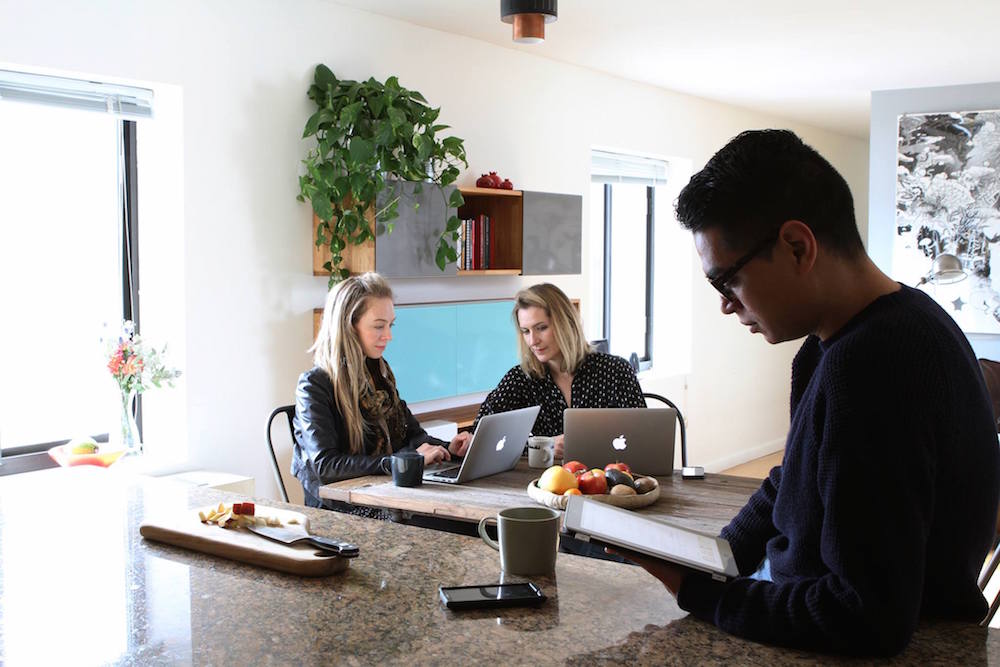
Working remotely is great because you can cut out commuting time, it makes you less bound to 9-5 workaday hours, it often allows you to work from anywhere in the world, you can spend more time with family and so on. But it can also be isolating, your home can be a minefield of distraction and even if you want to get out, you might not live near a coffee shop that’s cool with people hanging out all day after ordering a small coffee. A new venture called SpareChair is offering an alternative to work-from-home isolation and all-day Starbucks loitering, hooking you up with other remote workers to create insta-offices.

SpareChair works a lot like Airbnb, letting people open up their homes to the public for the purposes of coworking. Like Airbnb, SpareChair’s website has details about the space’s features (wifi, coffee, etc) and pictures of the space itself. There are peer reviews of both spaces and members to make sure everyone maintains a high level of quality and decorum.
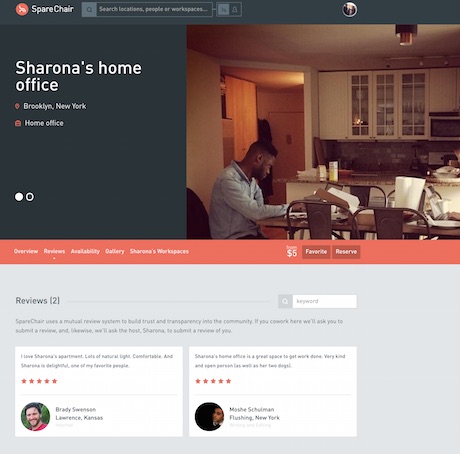
spare-chair

To book a coworking session, you first make a profile with your personal info: profession, short bio, etc. Then search for a space and navigate to its page where there will be a schedule of available times and vacancies. From there, request a session (e.g. Tuesday, March 17 10am-1pm), enter payment info and check out. Like Airbnb, the site’s host has to confirm the reservation in case several people reserve at the same time or there’s an unforeseen scheduling conflict. Many of the private spaces are as cheap as $5 for an all day session and few are more than $15 (SpareChair charges a small fee). They also have numerous coworking spaces on their network; these tend to run around $30/day–still pretty cheap if this is your primary office.

SpareChair co-founder Sharona Coutts told us she started SpareChair because she needed it. “I work from home and while I like the concept of coworking spaces, I didn’t necessarily want to go into one every day, or even randomly, since you don’t necessarily get to interact with people when you’re there. Plus, at $35 a day, it can be pricey.”

SpareChair wants to be more than a space to work; they are out to create community and help people advance their careers. “We had a writer’s coworking session on Tuesday night, and our members were able to help each other work on drafts, refine ideas and focus on writing for three hours,” Coutts told us. “Because we know what field each of our members works in, we can curate specialized events like that, and we can also pair people with each other, and with the right host. So, for example, if you’re a freelance designer, you could search for hosts who are designers or design firms, and go and cowork with them for a day, week or month. It’s pretty potent networking, without the awkwardness.”

SpareChair is still in beta mode so you’ll need to request an invite, but the site is expanding quickly and already has locations in NYC, the Bay Area, Santa Cruz, LA, Chicago, Boulder CO, Nashville, Minneapolis and others. They’ve also got requests from more than 40 countries, including Brazil, Norway, the UK and Thailand. Coutts sees big things for this simple idea. “SpareChair will be the world’s biggest and most meaningful community–both online and off–of people who work from home. We are building a space for people to cowork and network, as well as to monetize under-utilized space. We haven’t paid for any marketing. Our community in the US has grown to 700 strong based solely on word of mouth and press!”